Revd. John Parker
Origins
Llanyblodwel Church
Influences

John Parker (1798–1860) was the second son of Thomas Netherton Parker of Sweeney Hall, near Oswestry, Shropshire.
He was educated at Eton College and Oriel College, Oxford (B.A. 1820, M.A. 1825).
After ordination, he returned to the Welsh Borders, first serving as curate of Moreton near Oswestry, then as rector of St Llwchaiarn’s Church in Llanmerewig (1827–1844), and finally as vicar of Llanyblodwel from 1844 until his death.
Influences
Llanyblodwel Church
Influences
Parker developed a keen interest in Gothic architecture, botany, and topography during his education.
He was a talented watercolourist and draughtsman, which complemented his architectural pursuits.
His antiquarian studies and artistic sensibilities influenced his approach to church design and restoration, favouring visual effect and picturesque qualities over strict archaeological accuracy.
He was also an author, publishing the poem "The Passengers: Containing, the Celtic Annals" in 1831.
Llanyblodwel Church
Llanyblodwel Church
Llanyblodwel Church

Parker became rector of Llanyblodwel in 1844 and spent much of his life rebuilding St Michael’s Church, often at his own expense (reportedly £10,000).
He rebuilt the south wall of the nave, added aisles, porches, dormers, and galleries, and extensively decorated the interior with painted scripture and ornamentation.
The church’s interior features a large openwork timber arch, elaborate roofs, and benches with poppyheads, reflecting Parker's distinctive aesthetic.
He also designed the parish school and schoolmaster’s house nearby, both notable for their picturesque and idiosyncratic forms.
Llanyblodwel Spire
The Views of Others
Llanyblodwel Church

The most ambitious feature of St Michael’s Church is its unusual spire, designed and built by Parker in 1855–1856.
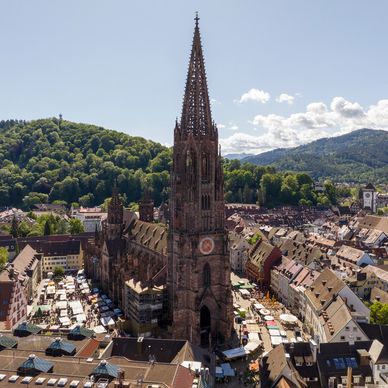
The spire is octagonal and domical, inspired by the spire of Freiburg Minster in Germany, which Parker studied closely.
He believed the convex outline of the spire provided both scientific and aesthetic advantages, aiming to avoid the "dangerous slight and thin" appearance of other English spires.
The spire is 104 feet high (tower 57 ft, spire 47 ft), with a radius of curvature of 247 ft, and is connected to the church by a short vestibule.
Parker left detailed memoranda about the construction, reflecting his blend of antiquarian interest and willingness to innovate using modern science.
The Views of Others
The Views of Others
The Views of Others
.jpg/:/cr=t:0%25,l:0%25,w:100%25,h:100%25/rs=w:388,h:388,cg:true)
John Betjeman in the first Shell Guide to Shropshire called John Parker a "19th Century genius" and the church "a fine example of good mid 19th Century building and embellishment"
The Pevsner Architectural Guides refer to the design as "bizarre" but "unforgettable", especially the spire.
Peter Howell, in The Faber Guide to Victorian Churches, described Parker's work as "dotty" but acknowledged his "artist’s eye" and the picturesque results.
Critics note that while Parker's approach was inventive and entertaining, his repertoire of forms was somewhat limited, with recurring motifs such as exaggerated rooflines and ornamentation.
His work is seen as a vivid example of a personal, gentleman-amateur vision, standing apart from the more serious High Victorian style that followed.